A Brief History of Sexy Lingerie
- Mar 27, 2016
- 5 min read
Underwear is a curious form of clothing: it can be entirely practical – there to maintain body heat, cover our modesty, and support the soft tissues of the body – or it can be a flirtatious symbol of sexual suggestiveness. While most of us trudge around in our comfy cotton briefs bought in a bargain multipack at M&S, we might soon be donning our sexiest pulling pants for Valentine’s Day, or even that hideous novelty posing pouch given to us at Christmas as a joke. Strangely, underwear is not meant to be seen; unless that’s exactly what it’s meant for. But when did the custom of wearing undies first begin?
Well, the mummified body of Ötzi the Iceman, who died in the Tyrolean Alps more than 5,000 years ago, reveals that he sported a goatskin loincloth under his furry leggings; and, if we skip forward 1,500 years to Bronze Age Egypt, you might be surprised to learn that Pharaoh Tutankhamun was entombed with 145 spare loincloths, presumably intended for use in the afterlife. This type of linen underwear (shenti) was a triangular nappy that fastened at the hips. For some Egyptian peasants these weren’t merely underwear – they constituted the entire outfit. King Tut, however, wore a manly skirt over his.
In ancient Rome, pants were known as subligaculum – a unisex garment made of leather and sometimes linen, available as shorts or loincloth, worn by gladiators, actors, and soldiers. Female performers, however, are known to have also worn an additional ‘boob tube’ – a flat bit of stretched-cloth – to protect their modesty. It’s not clear whether this garment found its way into an ordinary woman’s laundry basket.

Given the balmy climate, few Romans required socks, and indeed they were considered a sign of northern barbarism – though archaeological excavations at Vindolanda Fort, the Roman military camp just south of Hadrian’s Wall, show that the bitter Scottish wind required a bit of a rethink on that. Tablet 346 of the famous Vindolanda tablets states: "I have {sent} you ... pairs of socks from Sattua, two pairs of sandals and two pairs of underpants.” Well, at least it wasn’t 145 pairs.
It’s no surprise that in the chilly north, Celtic, Saxon, and Viking chaps were all keen to slide long socks over their tootsies, and insulate their private parts with baggy linen breeches (braies), though these weren’t technically underwear because nothing was worn over them.
Ladies, on the other hand, seem to have donned the long smock beneath their heavier dresses, but possibly didn’t bother with knickers at all. However, in 2012 building work at a medieval Austrian castle revealed a hidden vault beneath the 15th-century floorboards, and in this ‘time capsule’ were found four medieval bras with shoulder-straps. This discovery astonished costume historians, who had always declared the bra to be a 20th-century invention.
In Tudor times, stockings were the must-have accessory for European aristocracy, and silk was exalted for its cost and softness. Queen Elizabeth I of England was gifted her first pair of silkies in the 1560s, and – after comparing them to woollen ones – immediately declared: “I like silk stockings so well, because they are pleasant, fine and delicate, that henceforth I will wear no more cloth stockings."

Silk was far beyond the budget of most people, and knitted woollen stockings were much more common. For male aristocracy, nether-stockings reached all the way up to the waist, and were sewn into padded trunks decorated with the infamous codpiece – that projecting pouch of stiffened cloth that perched over a chap’s package like a cricketer’s protective box.
By contrast, ladies’ legwear stopped around the knee, and she was unlikely to wear knickers either; only wealthy Italian women of the 16th century were known to wear ‘drawers’. Instead, women wore ankle-length linen slips, while men tucked their shirt under their genitals. This was particularly the case during the 1600s, when it was feared that washing the body with water was liable to cause diseases to enter through the skin, so it was much safer to regularly change and launder one’s underwear instead.
Relying on layers of petticoats, then, most Western women only slipped into their drawers in the early 1800s, and by the 1840s these then evolved into the risqué pantalettes that frilled decoratively around the calves. Men continued tucking their shirt under their naughty bits well into the 1800s, but there had been a few early trendsetters: as early as the late 1600s, King Charles II wore 13 inch-long silk boxers, tightened around his regal waist with ribbons, while the diminutive King William III and II – who booted Charles’s Catholic brother, James II and VI, off the throne – was said to go to bed in rough woollen drawers, green socks and a red vest, making him presumably resemble one of Santa’s Christmas elves. It was also recently discovered that the philosopher Jeremy Bentham, who was mummified after his death in 1832, was wearing boxer shorts at his funeral.
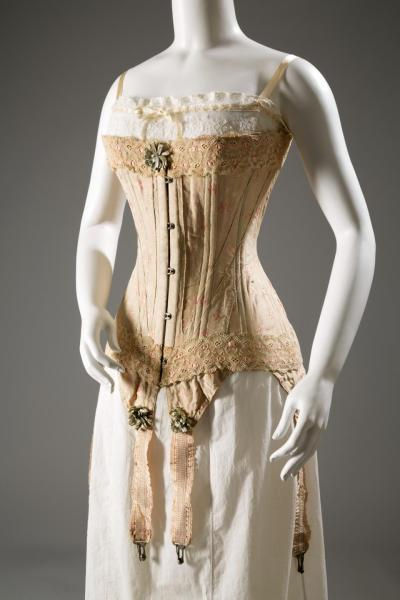
Bentham had lived through the fashion-crazed 18th century, when a new element of high status underwear entered the fray. Corsetry was commonly seen on the preening male Macaroni, but it was only their credibility and bank balance that suffered. Women, on the other hand, could be physically damaged by the trend for ‘tight-lacing’, which reached its nadir in the 19th century when the idealised female form was for tiny waists but broad hips. Most fashionable ladies strived for a circumference of just 21 inches, but the French-Algerian actress Émilie Marie Bouchaud, who performed under the stage-name of Polaire, was famed for her pneumatic 38inch bust and minuscule 16inch waist.
This crushing of the ribs with whalebone corsets inevitably could cause irreparable damage to the body. For most, bruising was a daily occurrence, breathing was tricky, and just climbing the stairs was enough to bring on dizzy spells – some ladies even wore corsets in pregnancy – but other common symptoms included muscular atrophy in the abdomen and back, reduced natural fertility, and, in the worst cases, organ failure.

By the early 20th century the fashion for boned-corseting dwindled, leaving in its wake just the supportive fabric girdle that connected the brassiere to the hold-up stockings and knickerbockers. This corselette, popular in the 1950s, was also then abandoned by young women in the 1960s, who elected instead to expose their belly buttons and embrace the simplicity of just bras and knickers.
But fashions are cyclical, and the retro look is now back in style. Stockings, girdles, brassieres and suspenders have remained as intimate lingerie for bedroom seduction, or saucy glamour modelling, and the return of the belly-squishing corset, in the form of the flattering Spanx, shows we’re not over the historical obsession with flat tummies…


KhelRaja is the leading Online lottery and money-making gaming platform, offering a secure, modern alternative to traditional ticketing. We provide access to global and local draws with seamless digital ticket purchases and instant payouts directly to your account. Our platform prioritizes user experience, fairness, and security, utilizing cutting-edge technology to ensure the integrity of every game. Join the thousands of players who trust KhelRaja for the best, most convenient, and most reliable way to play and win money online.